In the modern digital age, first impressions no longer happen in a courtroom — they happen online.
For law firms, your website is your digital handshake, your business card, and your reputation all rolled into one.
A strong law firm website design can help you build trust, attract clients, and establish authority in your legal niche. Whether you’re a solicitor, barrister, or legal consultant, your website needs to communicate professionalism and credibility from the very first click.
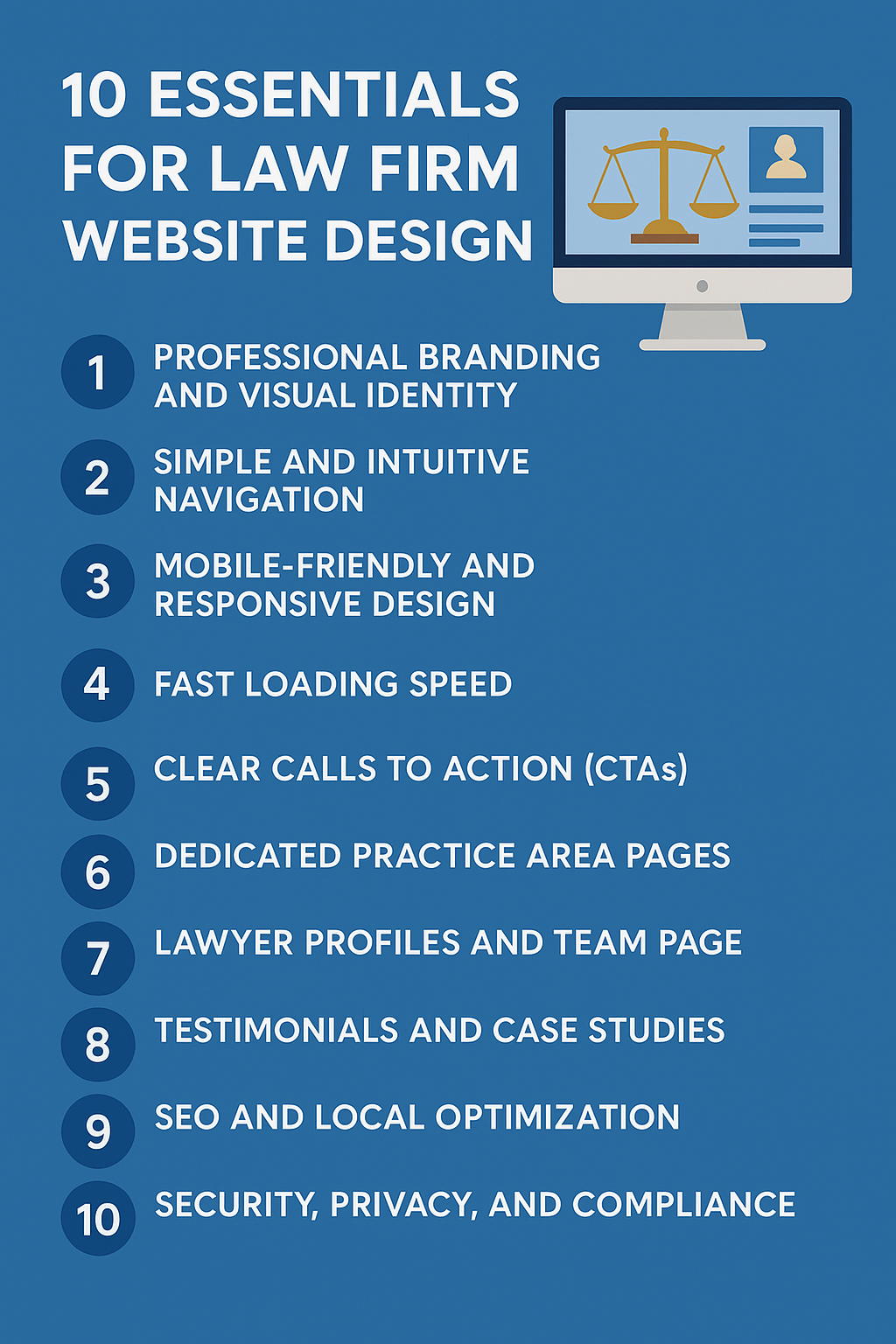
In this article, we’ll cover the 10 essential elements that every successful law firm website must have — and how they can transform your firm’s digital presence.
1️⃣ Professional Branding and Visual Identity
Your website should immediately communicate who you are and what you stand for.
Law is a trust-based industry — people hire firms they believe are competent, confident, and credible.
That begins with visual branding.
- Use consistent colors that convey confidence (navy blue, grey, black, and white work best).
- Choose clear, professional fonts like Lato, Roboto, or Merriweather.
- Display your logo in the header and favicon.
- Use professional photography of your team and office — avoid stock images when possible.
When your design is elegant and your messaging is consistent, clients instantly perceive your firm as reliable and trustworthy.
2️⃣ Simple and Intuitive Navigation
Think of your website as your digital reception area. Visitors should never feel lost or confused.
Keep your navigation clean and structured:
- Home
- About
- Practice Areas
- Our Team
- Testimonials
- Contact
Adding a sticky header with quick access to contact information (like a phone icon or “Book a Consultation” button) helps users take action quickly.
A clutter-free, logical structure makes it easy for users — and search engines — to find what they’re looking for.
3️⃣ Mobile-Friendly and Responsive Design
More than 65% of legal service searches now happen on smartphones.
If your site isn’t mobile-friendly, you’re losing leads before they even see your content.
Responsive law firm website design ensures that your layout adjusts automatically to fit any screen size — desktop, tablet, or mobile.
Google also prioritizes mobile-responsive websites in search rankings, which means mobile optimization isn’t optional — it’s a ranking factor.
Check your site’s responsiveness using tools like Google’s Mobile-Friendly Test.
4️⃣ Fast Loading Speed
A slow website can cost you clients.
Statistics show that a one-second delay can reduce conversions by 20%.
To optimize loading time:
- Compress large images using tools like TinyPNG.
- Use caching plugins (like WP Rocket or LiteSpeed Cache).
- Choose a reliable hosting provider.
- Minify CSS, JavaScript, and HTML.
A fast, efficient site gives users a smoother experience — and keeps Google’s algorithm on your side.
5️⃣ Clear Calls to Action (CTAs)
Your law firm’s website shouldn’t just inform — it should convert.
Every page should have a clear next step for the visitor:
- “Schedule a Consultation”
- “Request a Callback”
- “Speak to a Solicitor”
Place CTAs strategically in the header, after sections, and on mobile screens.
The goal is to make it effortless for potential clients to reach out when they’re ready.
6️⃣ Dedicated Practice Area Pages
Each legal service deserves its own optimized page.
If you provide multiple services — Family Law, Immigration Law, Criminal Defense, or Corporate Law — create separate pages for each.
Here’s why this matters:
- Each page targets specific keywords, improving SEO.
- Visitors can quickly find information relevant to their needs.
- You can add FAQs and case summaries to boost credibility.
This is one of the most effective on-page SEO techniques for law firms — Google can match each page with different search intents.
7️⃣ Lawyer Profiles and Team Page
Clients don’t just want to hire a firm — they want to know the people behind it.
Add a Meet Our Team section featuring professional photos, bios, and credentials. Include:
- Areas of specialization
- Education and certifications
- Years of experience
- Notable cases (where appropriate)
Humanizing your law firm builds connection and confidence — and often makes the difference between a click and a consultation.
8️⃣ Testimonials and Case Studies
Trust is the foundation of the legal industry, and social proof builds it instantly.
Showcase positive reviews and testimonials from clients (with permission). You can also share anonymized case summaries that demonstrate success.
Example:
“Our client faced a complex immigration case. With careful preparation and representation, we achieved a successful outcome within four weeks.”
Integrate star ratings from Google Reviews or Trustpilot if available.
Authentic feedback reinforces reliability and persuades hesitant visitors to take action.
9️⃣ SEO and Local Optimization
No matter how well-designed your website is, it won’t help if people can’t find it.
Implement SEO best practices tailored for law firms:
- Optimize meta titles, descriptions, and headers with keywords like law firm website design, family solicitor in London, immigration lawyer near me, etc.
- Use schema markup for legal services to improve search visibility.
- Create Google Business Profile and embed your map for local SEO.
- Build backlinks from reputable directories and legal associations.
- Add internal links between related service pages and blog posts.
A strong SEO foundation means your firm appears in search results when clients need help most.
🔟 Security, Privacy, and Compliance
Law firms handle sensitive information — and your website must reflect that.
To protect client data and comply with regulations:
- Install an SSL certificate (https:// → shows “Secure”).
- Include a clear Privacy Policy and Terms of Use.
- Use secure contact forms with spam protection (reCAPTCHA).
- Regularly update plugins and software.
Security not only protects clients but also strengthens Google ranking signals.
⚙️ Bonus: Analytics and Performance Tracking
Once your website is live, you need to understand how it’s performing.
Integrate tools like:
- Google Analytics 4 (GA4) – to track visitor behavior and conversions.
- Google Search Console – to monitor keyword rankings and indexing issues.
- Hotjar or Microsoft Clarity – to see how users interact with your pages visually.
Data reveals what’s working and what needs improvement — ensuring your law firm’s website keeps generating results.
🧭 Final Thoughts
A well-structured law firm website design does more than showcase your services — it builds authority, improves trust, and generates a consistent flow of client inquiries.
Each of the ten elements above — from branding to SEO — contributes to a cohesive, professional online experience that positions your firm as an industry leader.
Law is about reputation, and online, your website is your reputation. Make sure it communicates the professionalism and care you offer in every client interaction.
🌟 Need Expert Help Designing Your Law Firm Website?
If you’re ready to transform your firm’s online presence, it’s time to invest in design that reflects your professionalism.
I specialize in creating modern, SEO-driven, and high-performing websites for law firms across the UK and beyond — built on WordPress, optimized for speed, and tailored for results.
✅ Clean, mobile-responsive design
✅ SEO and analytics integration
✅ Privacy and compliance setup
✅ Google Business Profile optimization
Let’s craft a website that works as hard as you do for your clients.
👉 Visit my portfolio or connect with me directly on
Upwork or Fiverr to discuss your project today.

Leave a Reply